

10 Alternatives to popular software (Founder's Compass)
Hello there and welcome to Founder's Compass, a good way to get oriented around the labyrinthian world of startups.

Tool of the week: Pocketbase
Looking to deploy a database in 2 minutes or less?
Say less :) Pocketbase is built for Flutter, React Native, Vue, Svelte and many other modern javascript-based front-ends. This is literally the fastest database you can deploy on the internet. Self-hosted only, this tool is perfect if you want to prototype and test things on the fly. Even without optimizations, PocketBase can serve 10 000+ persistent realtime connections on a cheap $4 Hetzner CAX11 VPS (2vCPU, 4GB RAM).
Video(s) of the week: Alternatives to popular software
The definition of vendor lock-in: Google and their services. Can you imagine your life without the most common of their tools? Google Drive, Youtube, the search engine, the browser and many many more.
All that is collecting data on you, so some people might be looking for an escape from the clutches of Google. Here’s a quick tutorial to help you De-google your life:
But maybe you’re not only looking to De-Google your life, but also De-Adobe, De-Meta, De-everything really (and you also want to save hundreds of dollars per month in subscriptions).
Here’s where our second recommendation comes in: 10 alternatives to common SaaS apps that will save a buck and help you get that avocado toast weekly:
Top 5 stories of the week
“A growing body of scientific evidence shows that microplastics are accumulating in critical human organs, including the brain, leading researchers to call for more urgent actions to rein in plastic pollution.
Studies have detected tiny shards and specks of plastics in human lungs, placentas, reproductive organs, livers, kidneys, knee and elbow joints, blood vessels and bone marrow.”
“Stalwarts like Java, Javascript, and C++ also retain high rankings, but it’s what’s going on a little further down that’s particularly interesting. Typescript—a superset of Javascript—moves up several places on all the rankings, especially for Jobs, where it climbs to fourth place, versus 11th last year.”
“It's hard to sell simple, because simple looks easy, and who wants to pay for that? Of course, everyone says they want something simple, but the way they buy reveals that they usually don't.”
“Most companies, departments, and teams are horribly inefficient, have very little direction, are full of wasted time and efficiency, and are poorly run. It’s constant meetings to talk about the latest corporate fuckery, which only prevents you from doing what you should be doing. It’s change for the sake of change. And when you get excited about a way to fix things, either nobody listens, or they only pretend to before failing to implement it.”
“Being able to get code tailored to what I want is really helpful, and speeds up my work a lot. I like to work in small steps – getting a basic case working first, then adding functionality bit by bit. This workflow works well with ChatGPT. It is quite rare that I get an answer with an error in it.”
Funding & programs for startups
Two awesome programs to sign-up for this week:
They’re on the 👀 hunt for future unicorns. Don’t be shy — if you’ve got what it takes. Still unsure if it’s for you? Answer these quick Qs:
🟣 Are you building a tech startup?
🟣 Do you have a committed full-time team?
🟣 Could you use an investment, expert connections, and a 2-3X revenue boost?
If your A is 3YYY 👉 aka “yes, yes, yes,” you know what to do. But just in case you don’t — APPLY NOW. 😉
Designer Fund is a design and venture partner investing in early stage tech companies using design to improve health, climate, and prosperity for all. Investment offer of up to $1 million for Pre-seed to Series A startups.
Criteria:
Early stage startups, Pre-seed to Series A
Companies working to improve health, climate, or prosperity for all
Mission-driven founders who value design
Products that are 10x better compared to alternatives
Multi-billion dollar addressable markets with poor user experiences
Some updates
Let’s update you regarding what’s going on at Creative Motion & ReaktorX:
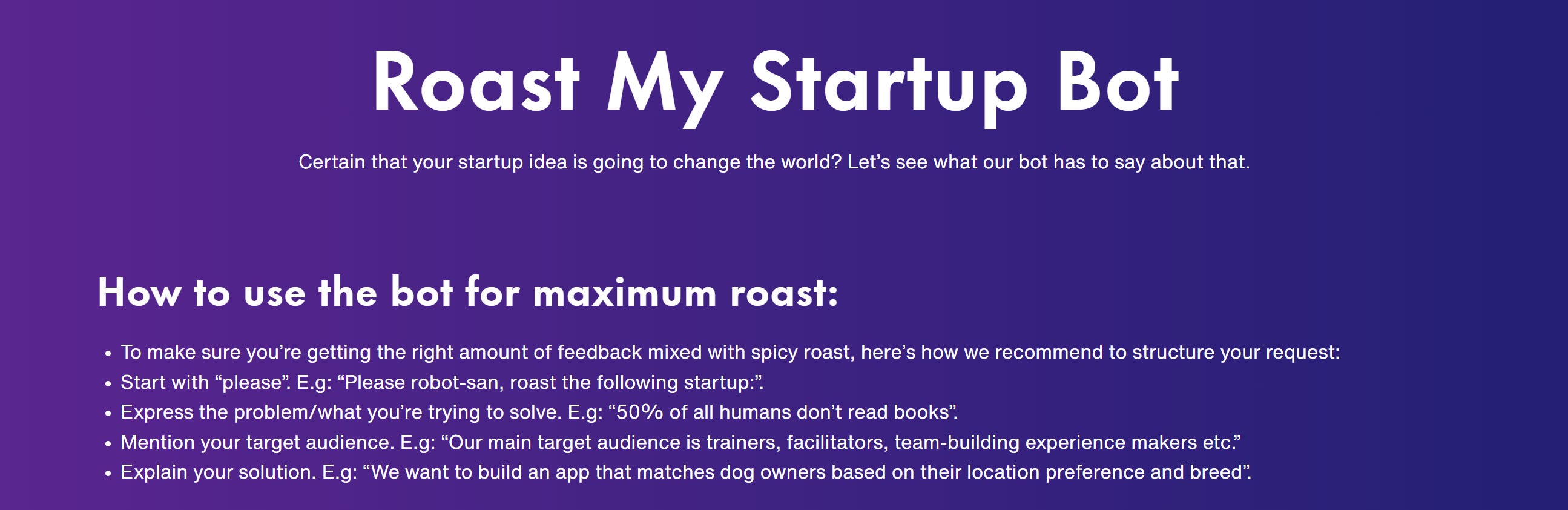
It’s live! We’ve kept this under wraps, but now it’s working like a charm. We’ve built a simple Startup Roasting bot. Try it out here.
Startup idea of the week: Mini sub-drones
Problem: War is raging on. We’re not fans of war right here, so the faster it ends, the better. All major players are developing their naval fleets, adding aircraft carrier after aircraft carrier.
We’ve seen the success of small, fast-moving aerial drones on the battlefields of Ukraine. What if we apply the same principals to Naval combat?
Target: Obviously Ukraine, but most probably United States (and more specifically the DoD).
Solution: A mini-sub drone, remotely controlled or autonomous, that targets large ships. The best part about building something like this is the damage to the ships will be minimal in terms of casualties, but critical in terms of use. No ship can last too long on the sea with multple holes in its hulls.
There’s also a use for demining the depths of seas and oceans during and after the conflict, with dual-use potential still uncertain honestly.
Benefits:
In-demand tech with plenty of funding available.
Clear use case and value add, militaries are also willing to experiment with anything that can give them the slightest edge in combat.
Potential pivots into other types of drones and different use cases for all the hard tech required to pull this off.
Challenges:
Really hard to implement remote control in submarine environments: Signal doesn’t travel the same way it travels through air.
Hardware component = really long development time.
By the time development is done, the conflicts might be over.
What would you do differently?
That's it for this week's edition. Stick close for the next one.